
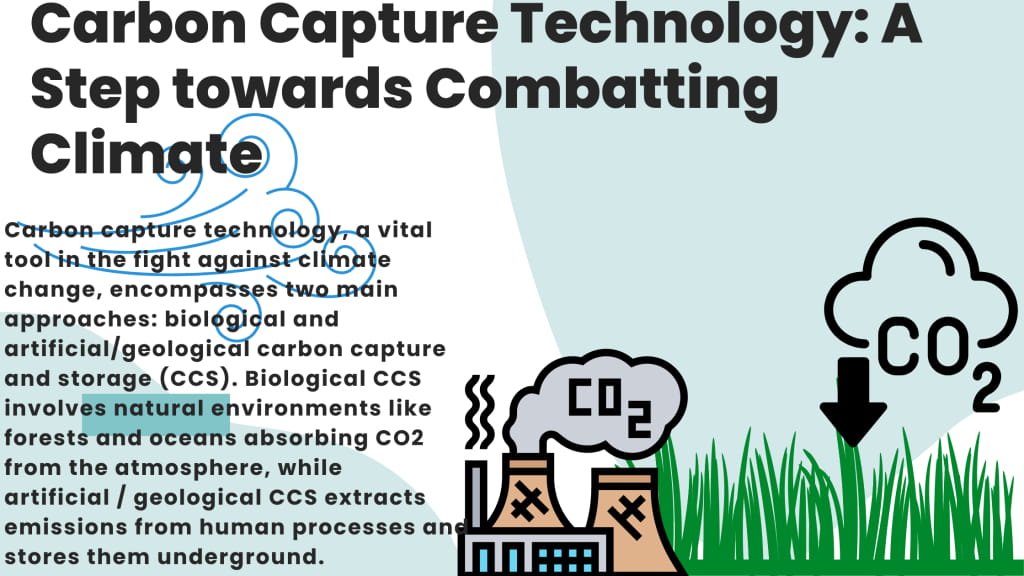

Carbon capture technology, a vital tool in the fight against climate change, encompasses two main approaches: biological and artificial/geological carbon capture and storage (CCS). Biological CCS involves natural environments like forests and oceans absorbing CO₂ from the atmosphere, while artificial / geological CCS extracts emissions from human processes and stores them underground. These methods, once considered expensive, are evolving due to increased investment and research. The concentration of CO₂ in the Earth’s atmosphere is approximately 0.04%. Despite this seemingly small proportion, the capacity of CO₂ to trap heat makes its increasing concentration a matter of significant concern. As reported by the Scripps Institution of Oceanography, the peak CO₂ level was recorded at 417.1 ppm in May 2020. This marked the highest seasonal peak in the 61-year span of recorded observations.

Natural carbon sinks, such as forests, oceans, grasslands, and wetlands, capture CO₂ from the atmosphere, with grasslands and wetlands being particularly efficient. Preserving and cultivating these sinks can rapidly reduce atmospheric carbon. For instance, specific trees like birch or willow are effective at land-based carbon capture
One project involves preserving an ancient peat bog in South Wales, storing the equivalent of 32,000 tons of CO₂ and benefiting local biodiversity. Deep saline aquifers, vast underground rock formations filled with salt water, have substantial storage potential for injected CO₂. The ‘Endurance’ aquifer in the UK’s North Sea and projects like the Citronelle project in the US showcase this technique’s efficacy.
Innovative approaches like massive air filters and ionic liquids show promise for carbon capture. China employs giant air-purifier towers, while ionic liquids offer efficient CO₂ absorption and environmentally friendly chemistry.
Biological Carbon Capture
Growing biological CCS involves tree planting and wetland development, requiring collaboration among governments, landowners, and communities. Financial incentives and offsetting emissions through carbon capture schemes are also becoming prevalent. For example, Microsoft invested in Climeworks’ Orca CCS facility, aiming to capture thousands of metric tons of CO₂ annually.
These evolving carbon capture methods hold significant potential in mitigating climate change while driving sustainable practices and innovation. There are several carbon capture technologies aimed at mitigating carbon dioxide emissions from various sources. Carbon capture technology, a vital tool in the fight against climate change, encompasses two main approaches: biological and artificial/geological carbon capture and storage (CCS). Biological CCS involves natural environments like forests and oceans absorbing CO₂ from the atmosphere, while artificial/geological CCS extracts emissions from human processes and stores them underground. These methods, once considered expensive, are evolving due to increased investment and research.

Supporting Carbon Dioxide Recovery with Purification and Liquefaction
Once captured, the CO2 can be purified to the level required by various use cases in industry. Many industrial applications, such as methanization, only require a low level of CO₂ in the gas, whereas food and beverage or electronics applications require very high or ultra-pure levels of CO₂. The CO2-enriched gas stream can be liquefied for delivery or supplied as pressurized gas to the end-user. Alternatively, the CO₂ can be sequestered to mitigate the climate impact of industrial processes that rely on the combustion of carbon-based fuels. Looking at post-combustion CO₂ capture (PCC), use cases include capturing carbon from the flue gases of SMR units as well as in power, cement, iron, and steel plants and many more. This adsorption-based technology supports all CO₂ product aggregate states (gaseous, liquid, and supercritical forms) and product purities meeting all industrial applications. As a one-stop shop, Linde provides an all-inclusive CO2 solution bundle.

Post-combustion Carbon capture
This involves capturing CO₂ after combustion processes, like in power plants. Solvent-based methods are commonly used to capture CO₂ from flue gases.
Pre-combustion Carbon capture
Here, carbon is removed from fuels before combustion. This is often used in integrated gasification combined cycle (IGCC) power plants, where syngas is produced and CO₂ is separated before combustion.
Oxy-fuel combustion
In this method, fuels are burned in an oxygen-rich environment, resulting in a flue gas primarily composed of CO₂ and water vapor, making it easier to capture CO₂.
Direct air capture (DAC)
DAC technologies directly capture CO₂ from the ambient air, often using chemical reactions or absorbent materials. Direct Air Capture (DAC) is a technology that removes carbon dioxide (CO₂) from the atmosphere.
Using high-powered fans, air is drawn into a processing facility where the CO₂ is separated through a series of chemical reactions. Then the CO₂ is either permanently stored in underground reservoirs through secure geologic sequestration or is used to make new products such as building materials and low-carbon fuels.
Bioenergy with carbon capture and storage (BECCS)
This combines biomass energy production with carbon capture and storage (CCS), where the CO₂ released during combustion is captured and stored underground.
Mineralization
CO₂ can be captured and converted into solid carbonate minerals through a process known as mineralization.
Industrial processes
Certain industrial processes can capture CO2 emissions before they are released into the atmosphere. For instance, cement and steel production can incorporate carbon capture.
Enhanced oil recovery (EOR)
This involves injecting captured CO₂ into oil reservoirs to increase oil extraction while simultaneously storing the CO₂ underground. This technique may also be used to increase the oil reservoirs in the future for the coming generation.
Ocean-based solutions
While controversial due to environmental concerns, some concepts propose capturing and storing CO₂ in deep ocean waters or converting it into solid carbonate minerals.
Ionic liquids
Carbon capture technology of the future?
The most recent advancements in CCS technology include new types of liquids, which are highly effective at absorbing CO₂. Two-dimensional ‘ionic’ liquids have a molecular structure that allows for higher rates of CO₂ to be absorbed. Scientists believe ‘editing’ liquids can offer more precise control in the chemical engineering process and are considered environmentally friendly.
Helping to ‘grow’ biological CCS for Carbon Capture
Planting trees or developing wetland areas are two of the simplest ways of stimulating CCS on huge scales, but there are often issues around land ownership and space. Governments, landowners, and local communities all have a role to play in identifying opportunities for projects and collaboration.
In the UK, financial incentives in the form of environmental land management schemes are offered to landowners and land managers who commit to managing their land in an environmentally sustainable way.
In the US, land reclamation for environmental purposes is similarly incentivized by the Department of Agriculture’s Farm Service Agency (FSA). Farmers can receive rental payments if they no longer develop on land or use it for agricultural purposes, allowing grasslands, uplands, wetlands, and forests to flourish instead.
Businesses in the private sector are increasingly ‘offsetting’ the emissions they produce by funding carbon capture schemes. This is also known as becoming carbon neutral through the purchase of ‘carbon credits.’
Microsoft has made its initial offset purchase through a $1 billion investment in Climeworks’ Orca CCS facility, located in Reykjavik. Climeworks opened the first commercial CCS facility in Switzerland in 2017, before opening the larger Orca site in 2021. It’s estimated that the Icelandic plant can capture up to 4,000 metric tons from the atmosphere annually.
Scientists from the Scripps Institution of Oceanography at the University of California, San Diego, have been meticulously measuring the levels of CO₂ in the Earth’s atmosphere at the Mauna Loa Observatory in Hawaii since 1958. Back then, the atmospheric CO₂ levels were below 320 parts per million (ppm), with an annual increase of around 0.8 ppm. However, over the last decade, this rate of increase has surged to a troubling 2.4 ppm per year.
Future Prospects of Carbon Capture
Potential for Mitigation
Discuss the potential of evolving carbon capture methods in mitigating climate change and driving sustainable practices.
Collective Effort for Carbon Capture
Emphasise the need for continued investment, research, and collaboration across sectors to achieve meaningful impact in combating climate change through carbon capture technology. Turn the world into renewable energy and reduce the waste as much as possible, and come out from your comfort zone and start walking a shorter distance.
Conclusion
Carbon capture technology has evolved from being considered expensive to becoming a crucial tool in addressing climate change. With diverse approaches such as biological and artificial/geological methods, natural carbon sinks, innovative technologies, and collaborative efforts, the fight against rising CO2 levels is gaining momentum. By harnessing these advancements, we have the potential to mitigate the effects of climate change and work towards a more sustainable future.