

In the rich tapestry of our world, color plays a pivotal role, infusing life with aesthetics and fascination. Throughout history, humans have harnessed the hues of plants, animals, and minerals to create colorants, dyes, and pigments. We will also discuss in the blog the captivating realm of dyes and pigments, shedding light on their structures, properties, and diverse applications.
Understanding Dyes and Pigments
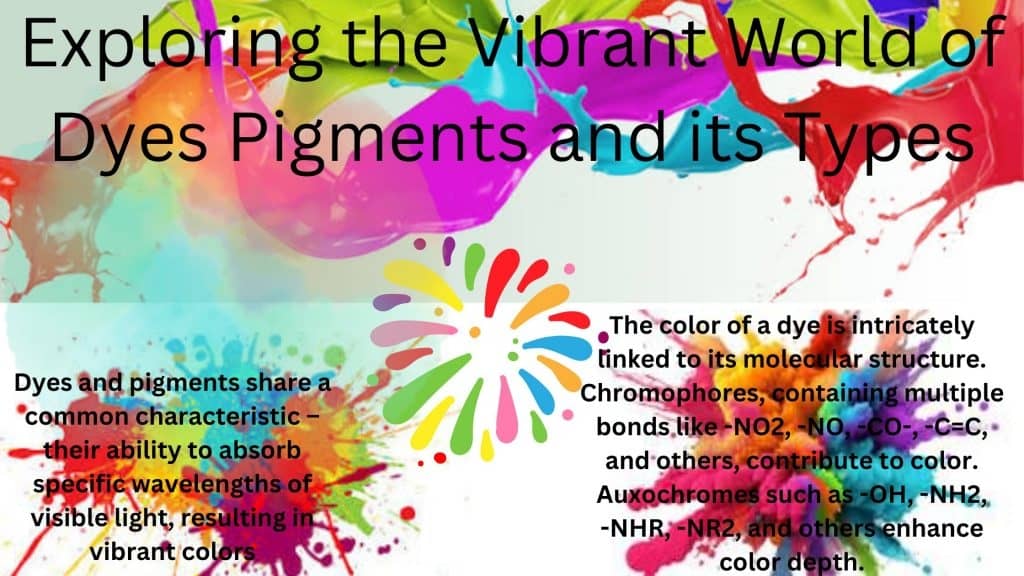
Dyes and pigments share a common characteristic—their ability to absorb specific wavelengths of visible light, resulting in vibrant colors. While the presence of Aryl rings with delocalized electron systems defines their structures. Dyes, colored organic compounds, find utility in various industries, coloring substrates like paper, leather, textiles, and more. On the other hand, pigments, both organic and inorganic, are insoluble in the mediums they are incorporated into.
Key features
Particle Size:
Pigments have a larger particle size than dyes, making them UV stable.
Solubility:
Dyes are generally water-soluble, while pigments are almost insoluble in water.
Composition:
Dyes are primarily organic, whereas pigments can be organic or inorganic.
Availability:
Dyes outnumber pigments in the market.
Color Imparting Mechanism:
Dyes rely on selective adsorption, whereas pigments can absorb color through selective adsorption or light scattering.
Combustibility:
Dyes are combustible, while pigments are non-combustible.
Lifespan:
Dyes have a shorter lifespan compared to pigments.
Evolution of Colorants
Throughout history, various civilizations discovered natural colorants like indigo, Tyrian purple, alizarin, and cochineal. Such as the first synthetic dyes emerged in the early 20th century, with applications ranging from aesthetics to medicinal purposes.
Textile Industry Dynamics
The textile industry, a major consumer of dyes, has witnessed a shift toward synthetic dyes derived from coal tar and petroleum-based intermediates. The advent of new technologies, fabric types, and environmental considerations has driven the continuous innovation of dyes, especially in the realm of polyester usage.
Reasons Behind Dye Colors
The color of a dye is intricately linked to its molecular structure. Chromophores, containing multiple bonds like -NO₂, -NO, -CO-, -C=C, and others, contribute to color. Auxochromes such as -OH, -NH₂, -NHR, -NR₂, and others enhance color depth. Although many theories have been given to correlate the color of dyes with their molecular structure. Such as in 1876, Otto Witt, a German chemist, observed that the color of a dye is due to certain groups containing multiple bonds known as chromophores. Some examples of the chromophores are the nitro group (-NO₂), nitroso group (-NO), carbonyl group (-CO-), ethylenic bond (-C=C), acetylenic bond, etc. As the number of chromophores increases for a dye, the color of the dye also deepens.
Chromophore
A chromophore is a molecular group or atom within a larger molecule that is responsible for the molecule’s color. Chromophores are characterized by their ability to absorb certain wavelengths of light, particularly in the visible region of the electromagnetic spectrum. For example, the presence of conjugated double bonds or other unsaturated structures in a chromophore allows it to interact with light and give rise to color in compounds. Examples of chromophores include groups such as -NO₂ (nitro group), -NO (nitroso group), -CO- (carbonyl group), -C=C (ethylenic bond), and other similar structures.
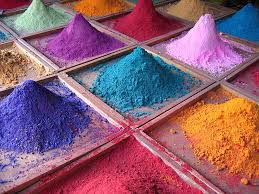
Dyes and Pigments: The Colors for the Textile Industry
Auxochrome in Dyes and Pigments
An auxochrome is a functional group or atom in a molecule that, while not directly responsible for the color of the molecule, intensifies or modifies the color when attached to a chromophore. Auxochromes typically enhance the color of a compound by altering its electronic structure, also affecting the way the chromophore interacts with light. Common auxochromes include -OH (hydroxyl group), -NH₂ (amino group), -NHR (substituted amino group), -NR₂ (dialkylamino group), and other groups that can influence the overall color of a molecule by their presence near the chromophore.
Focus on Acid Dyes Pigments
Focus on Acid Dyes: Acid dyes, employed for protein-based fibers like wool and silk, showcase excellent colorfastness. While their classification based on chemical structure and application, along with properties of strong, weak, and neutral acid dyes, provides insights into their diverse uses.
Types of Acid dyes
1. Nitro
2. Nitroso
3. Mono Azo
4. Diazo
5. Triphenyl methane
6. Xanthan
7. Azin
8. Quinaline
9. Ketorenine
10. Anthraquinone
Conclusion
Dyes and pigments, with their rich history and diverse applications, continue to shape the colorful tapestry of our world. From ancient civilizations to modern industries, these colorants add vibrancy and beauty to the fabrics, materials, and products we encounter daily. By using colorful clothes, it also makes life beautiful and fashionable.