

Electrochemical Sensor for Waste Water analysis plays a significant role in air quality environmental monitoring, offering a range of techniques and methods to detect, quantify, and assess various chemical species and parameters in environmental samples. In recent years, growing apprehensions about the harmful impacts of chemicals in the environment have underscored the importance of monitoring pollutant levels at multiple junctures within industrial and recycling processes, in wastewater and effluents, and at industrial, agricultural, and urban locations. However, the ongoing need for real-time environmental pollution monitoring in the field necessitates durable, portable sensors that can provide rapid responses, maintain sensitivity, and have a long operational lifespan.
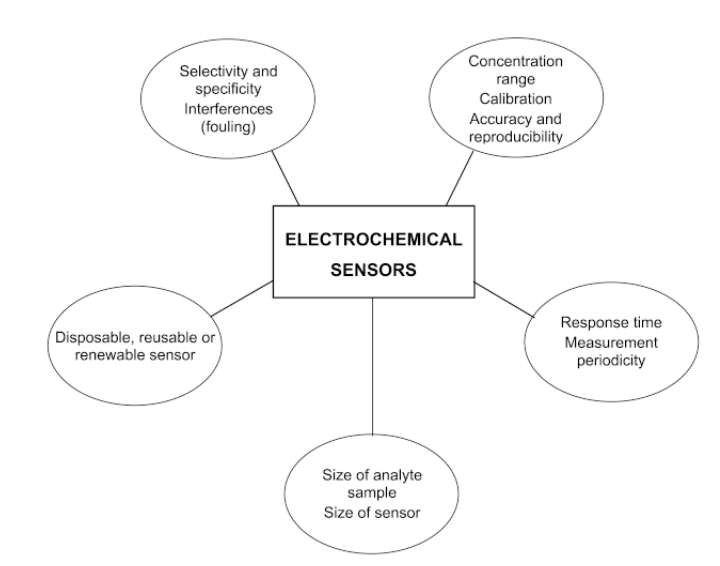
There are three types of electroanalytical measurements, each offering varying degrees of selectivity.
Conductometric
Conductometric measurements determine the concentration of charge by assessing solution resistance, and they are not highly selective to specific species. These detectors are useful in scenarios where the goal is to confirm if the total ion concentration is below a specific permissible level. Such as an online detector following the separation of ion mixtures, such as in electroremediation processes.
Potentiometric
Potentiometric measurements involve gauging the equilibrium potential of an indicator electrode compared to a chosen reference electrode using a high-impedance voltmeter, effectively at zero current. In inert redox indicator electrodes like platinum, the measured potential represents a mixed potential influenced by all species in the solution and their concentrations. Ion-selective electrodes can offer good selectivity for a particular species, often with minimal interference from other ions. Detection limits can reach approximately 100 nanomoles per liter of the total ion concentration in a specific oxidation state. While differences as low as 10 picomolar in concentration can be discerned.
Voltammetric
Voltammetric measurements involve registering current as a function of applied potential, providing more detailed information and lower detection limits. They can simultaneously determine several species reacting at different applied potentials in the same experiment, eliminating the need for prior separation. With advanced instrumentation and analyte pre-concentration on the electrode surface. The voltammetry can achieve very low detection limits, even down to the picomolar level. In practical applications, such as sensors or detectors used after separation techniques like high-pressure liquid chromatography or capillary electrophoresis, amperometric sensors at fixed potential can be employed following the investigation of the voltammetric profile.
Electrochemical analysis contribution
Water Quality Assessment by Electrochemical Sensor WasteWater
The pH Measurement Electrochemical pH sensors provide accurate and continuous monitoring of pH levels in water bodies. The pH is a critical parameter in assessing water quality and its suitability for aquatic life and human consumption.
Dissolved Oxygen (DO) Measurement by Electrochemical Sensor WasteWater
Electrochemical DO sensors measure the concentration of oxygen in water. However, this is essential for evaluating the health of aquatic ecosystems and wastewater treatment processes.
Detection of Pollutants by Electrochemical Sensor WasteWater
Electrochemical techniques, such as anodic stripping voltammetry, are also used to detect and quantify trace levels of heavy metals like lead, mercury, and cadmium in water samples. It is also helpful in air quality monitoring while analyzing metal analysis in airborne dust.
Organic Pollutants & Electrochemical Sensor WasteWater
Electrochemical sensors and biosensors can be designed to detect organic contaminants like pesticides, phenolic compounds, and hydrocarbons.
Inorganic Ions & Electrochemical Sensor WasteWater
Ion-selective electrodes (ISEs) may be used for the selective determination of specific ions like nitrate, phosphate, and chloride in water samples. Analysis of inorganic ions in air quality in the dust pollutants for these dust samples is dissolved in water.
Environmental Redox Processes
Electrochemical analysis helps in understanding redox processes in environmental systems. Such as the transformation of pollutants, the cycling of nutrients, and the behavior of electron transfer reactions in natural waters.
Biosensor Development
Electrochemical biosensors are tailored for environmental monitoring by detecting specific biomarkers, pathogens, or contaminants in samples. These sensors can offer high sensitivity and selectivity.
Real-time Monitoring
Portable and automated electrochemical instruments allow for real-time monitoring of critical environmental parameters. However, that enables rapid responses to pollution events and the assessment of dynamic changes in water quality.
Corrosion Monitoring
Electrochemical techniques are used to monitor the corrosion of metal structures in aquatic environments. Therefore, help prevent infrastructure damage and assess the environmental impact of corrosion-related processes.
Electrochemical Sensor & WasteWater Analysis
Electrochemical sensors and analyzers are deployed in wastewater treatment plants to assess the quality of effluents and ensure compliance with discharge standards. Water analysis is using an electrochemical analyzer as a tool for analysis. However, wastewater has characteristics like pH, total dissolved solids (TDS), ammonia, and also other pollutants.
Air Quality Monitoring
Electrochemical sensors are used to measure gaseous pollutants in the atmosphere, such as carbon monoxide (CO), nitrogen dioxide (NO₂), and ozone (O₃). These sensors are essential for air quality assessment and health protection and also for environmental pollution.
Soil Analysis
Electrochemical techniques can be adapted for soil analysis, helping assess soil contamination, nutrient levels, and redox potential, which are critical for agriculture and environmental management. These are also used for analysis to monitor the contamination in soil for environmental analysis and prevent soil pollution to save the earth.
Electrochemical data also supports scientific research on environmental issues. Because it assists regulatory agencies in establishing and enforcing environmental standards and regulations.
Electrochemical analysis is a versatile and valuable tool in environmental monitoring. Because it enables precise and real-time measurement of critical parameters and the detection of pollutants, facilitating efforts to protect and manage the environment effectively.