

What is environmental health?
Environmental health is a branch of public health that focuses on the interactions between people and their environment, aiming to promote human health and well-being by identifying and mitigating environmental hazards. However, it encompasses a wide range of factors, including air and water quality, exposure to toxins, and the impact of climate change. Environmental health studies the impact of the natural and physical environment on human health, focusing on factors like chemicals, radiation, and microbiological agents. Because it is used to assess and control environmental factors that can lead to disease and promote environments that support health.
Learn about the pressing need to address environmental health concerns and collaborate across disciplines for sustainable solutions. Protecting the human environment is critical for the future.
Environmental Health Issues
Air pollution due to industries’ emissions, vehicular emissions, and roadside dust as well as increasing the carbon footprint. However, air contaminants in both indoor and outdoor air pollution can cause respiratory and other health problems.
Water contamination due to industrial effluents, municipal waste effluents, and agricultural runoff. As microbial contamination and chemical pollutants in water can lead to disease and harm.
Exposure to toxins from industries and agricultural fields through drinking water (groundwater) and air from pesticides and fertilizers used for crops. However, exposure to chemicals, like those found in pesticides or industrial waste, can have both short-term and long-term health effects.
Climate change due to increasing levels of greenhouse gases in the environment results in increasing temperatures and unexpected weather events. Climate change can exacerbate existing health problems and create new ones, such as heat waves and extreme weather events.
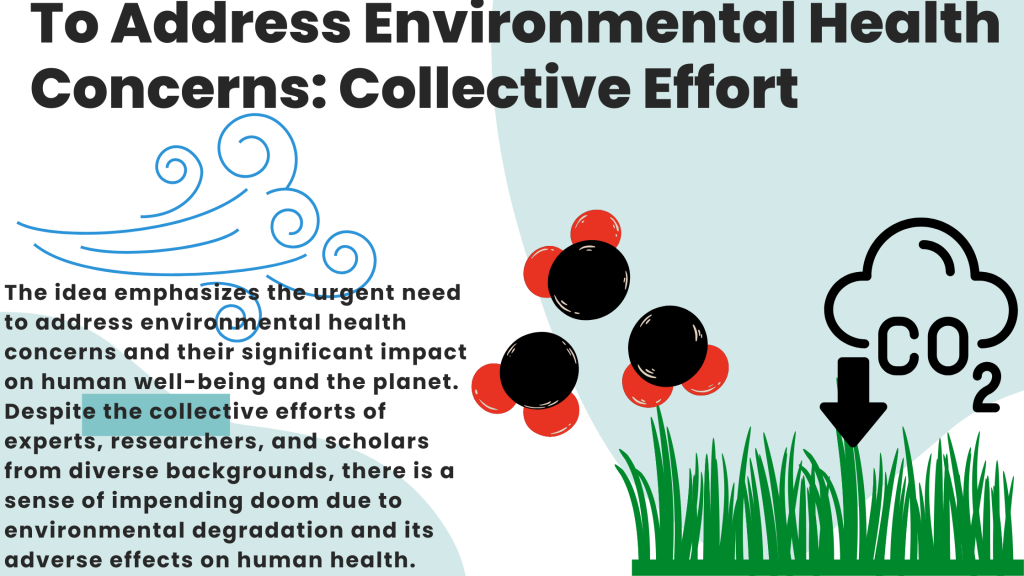
The idea emphasizes the urgent need to address environmental health concerns and their significant impact on human well-being and the planet. Despite the collective efforts of experts, researchers, and scholars from diverse backgrounds, there is a sense of impending doom due to environmental degradation and its adverse effects on human health.
Collective Effort
The rising prevalence of severe diseases among young generations, likely linked to environmental factors, raises alarming concerns. Additionally, the idea acknowledges the reality of climate change. Furthermore, with escalating global temperatures, extreme weather events, and rising sea levels, all signalling the urgency for immediate and cohesive action.
New Idea About Climate Change
Effectively combating these challenges requires collaboration among experts and stakeholders. That includes environmental natural scientists, activists, government agencies, community leaders, regulators, and nations, irrespective of their developmental status. However, integrating knowledge from diverse disciplines is critical in understanding the intricacies of environmental issues. The government develops comprehensive solutions on the basis of pollution load from monitoring.
Addressing these complex challenges necessitates nurturing a new generation of scientists. However, equipped not only with discipline-specific expertise but also with the ability to collaborate and communicate across fields. Interdisciplinary, collaborative teamwork is essential in confronting the complex global environmental issues and monitoring.
Core Idea
The idea underscores the gravity of environmental health concerns and advocates for united efforts and interdisciplinary collaboration to protect and sustain the future of the human environment. While empowering a new generation of scientists with diverse skills. We can pave the way for innovative and holistic solutions to safeguard both human health and the planet’s well-being. It is time to change the mind to control the climate change through the environmental health of our planet.